
Rate structure
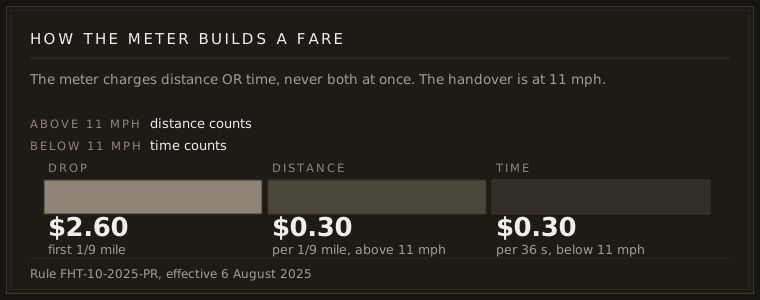
How the Seattle taxi meter builds a fare
- Drop
- $2.60on entering, covers the first ninth of a mile
- Per mile
- $2.70charged as $0.30 per ninth of a mile above 11 mph
- Per minute
- $0.50charged as $0.30 per 36 seconds below 11 mph
Seattle taxi fares begin before the wheels turn. The number that appears the moment the door closes is the drop rate, and in Seattle it is $2.60. That figure is not a booking fee in the usual sense: it buys the first ninth of a mile, so a passenger who changes their mind on the kerb has already paid for a short stretch of road they never used.
After that first ninth, the meter switches between two ways of counting and only ever uses one at a time. Above eleven miles an hour it counts distance, adding $0.30 for every further ninth of a mile, which works out to the $2.70 per mile most people quote. Below eleven miles an hour it counts time instead, at $0.30 per thirty-six seconds, or $0.50 a minute. The switch is what makes an identical route cost differently at eight in the morning and at eleven at night: the mileage is fixed, the crawl is not.
Both halves of the Seattle taxi rates are written into the joint rule that the City of Seattle and King County issue together, currently rule FHT-10-2025-PR, in force since 6 August 2025. Because the two jurisdictions publish it as one document, a cab licensed in Seattle and a cab licensed by the county run the same meter, and a passenger crossing the city line partway through a trip sees no change in the rate.
| Component | How the rule expresses it | Amount |
|---|---|---|
| Drop rate | First one-ninth-mile increment | $2.60 |
| Distance rate | Each further one-ninth-mile increment, above 11 mph | $0.30 |
| Time rate | Per 36 seconds, below 11 mph | $0.30 |
| Extra passenger | Per person beyond two, not counting children under twelve | $0.50 |
Source: City of Seattle Director’s Rule FOR-HIRE TRANSPORTATION-11-2025 and King County Public Rule FHT-10-2025-PR, Fares and Rates for Taxicabs and For-Hire Vehicles, effective 6 August 2025, issued under SMC 6.311.380 and KCC 6.65.380.
The distance charge
What a taxi costs per mile in Seattle, and why the meter says $0.30
Of the three Seattle taxi rates, the distance charge is the one people misread. A meter that advances in thirty-cent steps looks stranger than it is. Nine steps of $0.30 make $2.70, and the ninth-of-a-mile increment exists so that a short hop is not rounded up to a full mile. The consequence worth knowing is that the meter can tick over while the cab is stationary at a light and then tick again the moment it moves, because the two counters hand off at eleven miles an hour, not at zero.
For a rough estimate of taxi fares on a given route, the arithmetic is the drop plus the mileage plus whatever the traffic adds. A four-mile run across the city with no serious delay sits a little over thirteen dollars before tip and tolls. The same four miles through the downtown core at five in the afternoon can add several dollars in time charges alone, which is why quoted “average” fares between two neighbourhoods are worth treating as a floor, never as a figure.
Extra passengers
A third and fourth adult each add $0.50, and children under twelve are not counted at all. The charge is per person, and it applies to the people in the vehicle rather than to the number of stops.
Wheelchair-accessible vehicles
Charging more to carry a passenger with a disability is prohibited outright unless the trip runs under a negotiated contract rate. Where a dispatch agency sets different rates by vehicle size, the rule closes the obvious loophole: when a large wheelchair-accessible vehicle carries a wheelchair user and up to four other passengers, the small-car rate applies regardless. The extra-passenger charge can still appear once there are more than two people aboard.
One detail sits inside the drop rate, not beside it: accessibility is funded within the metered rate rather than charged as a separate line. The rule states the prohibition directly – additional charges for transporting a person with a disability are not allowed outside a contract rate – so there is nothing for a passenger to look for on the receipt.
The airport
Sea-Tac: a $20 minimum, and a flat rate the rule does not set
Almost every guide to Seattle quotes a flat rate of about forty dollars between downtown and Seattle-Tacoma International. The regional rule is unusually blunt about this. In its own words, it “does not establish any flat rate between downtown Seattle and Seattle-Tacoma International Airport (SEA) or between Seattle-Tacoma International Airport (SEA) and downtown Seattle.” A dispatch agency may create one if it wants to, and some do, but no ordinance obliges anyone to honour a number a passenger read on a travel forum.
What the rule does set is a floor. Any taxi or for-hire trip originating at Sea-Tac carries a minimum fare of $20, before fees, surcharges and tolls. The driver has to start the meter on every departing trip whatever the destination; if the metered fare comes in under twenty dollars the minimum applies, and if it comes in above, the meter wins. A five-minute run to a hotel on International Boulevard therefore costs the same twenty dollars as a considerably longer one.
Port of Seattle fees are layered on top of that minimum wherever the Port allows them to be passed through, which is why an airport receipt often carries a line that a city receipt does not. Trips toward the airport are ordinary metered trips: the minimum is a departure rule, not a route rule.
How the Sea-Tac taxi rank works covers the ground-transport side of the trip separately.
Added to the meter
Tolls, card fees and the fuel surcharge on Seattle taxi fares
Three things can appear on a fare that the meter itself never displays, and they behave differently from one another. Each has its own dedicated treatment: what may be added above the meter and how the fuel surcharge is triggered and removed. None of them is part of the Seattle taxi rates proper; all three are added on top of whatever the meter reads.
Tolls
Bridge, tunnel, road and ferry charges incurred while a passenger is aboard may be added to the total. The exception matters: if the fare was presented and agreed before the trip began, the toll cannot be bolted on afterwards. An up-front price is a price.
Paying by card
The often-repeated claim that card surcharges are banned in Seattle cabs is not quite right. A convenience fee for electronic payment exists as a regulated instrument: it has to be requested in writing by the dispatch agency, authorised by the Director, and then applied across the whole fleet, never at a driver’s discretion. What the rule genuinely forbids is charging it on a fare paid in cash or by voucher.
The temporary fuel surcharge
A per-trip fuel surcharge switches on when pump prices stay above a trigger for fourteen consecutive days, measured against the AAA average for the Seattle-Bellevue-Everett area. It starts at a dollar when regular unleaded reaches five dollars a gallon and climbs fifty cents for every further fifty cents at the pump; below four dollars there is none. Contract-rate trips are exempt. Whether one is running at any given moment is posted on a notice on the dashboard, so the vehicle answers that question more reliably than a web page can.
| Regular unleaded, per gallon | Surcharge per trip |
|---|---|
| $4.00 | None |
| $5.00 | $1.00 |
| $5.50 | $1.50 |
| $6.00 | $2.00 |
| $6.50 | $2.50 |
| $7.00 | $3.00 |
| $7.50 | $3.50 |
When the meter is not the price
The Seattle taxi rates that are not the meter at all
The regional taximeter rate is the default, not the only option. The same rule authorises a dispatch agency to price a trip by flat rate between two addresses or two ZIP-code zones, by contract with a business or agency, by an up-front fare quoted from the smart meter’s own estimate, or by a dynamic rate that moves with time of day and demand. A company may also file its own meter schedule, in which case the rules on posting rates require them inside and outside every affiliated vehicle.
Two safeguards run through all of it. Any alternative to the meter has to be presented to the passenger before the trip is confirmed, and the choice of rate type belongs to the dispatch agency, not to the individual driver. Where an up-front fare is offered and no other alternative rate is in force, a passenger may decline it and ask for the meter instead.
One structural change landed quietly on 31 March 2026: the separate category of for-hire vehicle ceased to exist, and every such vehicle transitioned to taxicab status under the regional rate. The practical effect for a passenger is that the old distinction between a metered taxi and a rate-book for-hire car no longer describes anything on the street, in the city or out in the south valley.
The full list
The nine rate types a Seattle taxi may use instead of the meter

The summary above names the common ones. The rule actually authorises nine, and reading the whole list explains most of the odd numbers passengers report. A dispatch agency picks which of them it operates; the driver in the car does not choose, and cannot invent a tenth.
- Flat rate. A fixed charge from one address to another, or from one defined zone to another defined zone. The rule gives Colman Dock to the airport as its own example, and adds explicitly that it establishes no flat rate itself between downtown and Sea-Tac in either direction.
- Contract rate. A price fixed by written contract between the dispatch agency and a business, a non-profit or a government body. Contract trips sit outside several of the rules that govern ordinary fares, including the fuel surcharge.
- Up-front fare. For a hailed trip, the smart meter estimates time and distance and multiplies by the regional rate. The quote has to include estimated surcharges, tolls and fees, be confirmed before the trip starts, and be the final charge at the end. Tips and card convenience fees sit outside it.
- Dynamic rate. A price that moves on a published schedule by time of day or day of week, or one the meter calculates from live traffic, routing, demand, vehicle supply or a special event.
- Company meter schedule. A dispatch agency may file its own meter rates, which must contain a starting rate, a time rate, a distance rate and a per-extra-passenger rate. A company on its own schedule posts those rates inside and outside every affiliated vehicle, and may not add a fuel surcharge of its own.
- Split fare. The cost is divided equally among passengers who accept the invitation to split, or proportionately where pick-ups and destinations differ. A fee may be charged for each portion.
- Bid trip. Companies, or drivers within one company, bid against a trip a passenger has defined. In practice this runs through an app.
- Minimum rate or flat-rate fare. A floor amount set for specific trips. The rule takes care to say that a minimum is a different instrument from the drop rate, which buys the first ninth of a mile.
- Vehicle size rate. A price tied to the size of vehicle a trip needs, or to one the passenger asked for. It may never cut across the accessibility protections: a large wheelchair-accessible vehicle carrying a wheelchair user and up to four other passengers is billed at the small-car rate.
An alternative rate is programmed into the meter system by the vendor or the dispatch agency, and the programming has to enable the passenger to see it in advance. The Director may ask a company to produce any rate type it has established for inspection, which is what keeps the list from becoming decorative.
What you may refuse
Advance presentation, and which taxi fares a passenger can decline
The rule defines advance presentation as showing a rate, fare or price to the passenger so it can be considered before the trip is confirmed. Which quoted fares a passenger may refuse is set out separately. It is required for every alternative rate type a company uses, and it is the mechanism that separates a quoted price from a bill handed over at the kerb.
What a passenger may do with that presentation depends on which instrument produced it, and the asymmetry is easy to miss. Given an up-front fare when no other alternative rate is in force, a passenger may reject the fare outright and ask the driver to run the regional meter rate instead. Given a properly presented alternative rate, such as a flat rate or a dynamic rate, a passenger may reject or confirm the trip, and may not reject the rate: the choice is the whole trip or none of it.
When the trip changes after it starts
Adding a stop or changing the destination after an accepted quote has its own provision. The driver may update the destination so the meter issues a new fare, or, where the meter is configured with a fallback, the trip reverts to the posted meter rates displayed from the point at which it began. Either way the passenger is not left paying a quote for a journey that no longer resembles the one quoted.
Throughout all of this the meter keeps working. It is programmed to display the rate charged for that trip from activation to completion, so the metered value is recorded even while an alternative rate decides what is actually paid. The Director investigates complaints about not being presented a rate before confirming a trip, which makes the receipt the natural place to start when a quoted price and a final price disagree.
Questions
Common questions about Seattle taxi rates
How much is a taxi from Sea-Tac to downtown Seattle?
There is no regulated flat rate for that trip in either direction. The fare runs on the meter, subject to a $20 minimum because the trip starts at the airport, plus any Port of Seattle fee that is passed through. Individual dispatch agencies are free to publish their own flat rate, and if one applies it must be shown to you before you confirm the trip.
What is the flag drop on a Seattle taxi?
$2.60, and it covers the first ninth of a mile, so it is not a pure booking charge.
Do Seattle taxi rates change between companies?
Not for the regional meter rate, which is identical across every licensed vehicle in Seattle and unincorporated King County. A company may file its own meter schedule or use flat and dynamic rates instead, and when it does, the rates have to be posted on the vehicle and shown to you in advance.
Can a Seattle taxi charge extra for a credit card?
Only through a convenience fee authorised across the whole fleet and requested in writing by the dispatch agency. It cannot be added to a fare paid in cash or by voucher, and it is not something a driver can decide to apply.
Why did the meter keep running while we were stopped?
Below eleven miles an hour the meter charges time instead of distance, at $0.30 per thirty-six seconds. Standing at a light is billed the same way as crawling through traffic.