The trigger
What has to happen before a surcharge can be added
A fuel surcharge is not a decision a driver or a dispatch company makes. It is authorised by the Director, and only after an external price has stayed above a published level for a set period. The reference is the American Automobile Association’s figure for the Seattle-Bellevue-Everett zone, taken from gasprices.aaa.com, so the number that governs a Seattle cab fare is one a passenger can look up independently.
The period is the part people miss. The rule requires that “the current price of fuel must remain at or above a trigger level in the table for 14 consecutive days before a surcharge, or an increase in the surcharge, may be authorized by the Director”. A single expensive week at the pump changes nothing. Two consecutive weeks above a step is the threshold, and the same wording governs an increase as governs a first authorisation.
That design has a visible consequence in a volatile year: the surcharge lags the pump in both directions. Fuel can climb sharply and fares stay flat for a fortnight, and fuel can fall and the surcharge stay on for a fortnight more.
The table
The published steps, and what happens above them
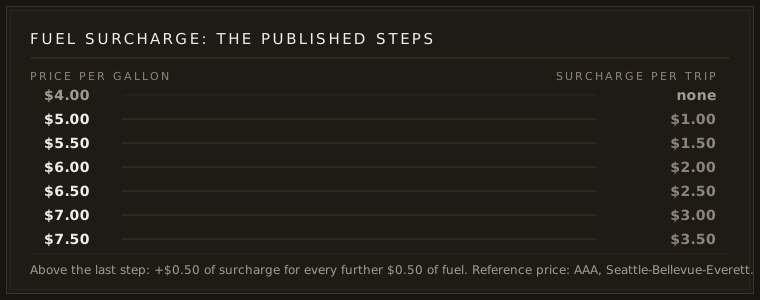
Seven steps are printed in the rule. At four dollars a gallon there is no surcharge at all; the ladder begins above that and rises in fifty-cent increments of fuel price.
- $4.00 a gallon
- nonethe floor of the table
- $5.00 a gallon
- $1.00per trip, not per mile
- $7.50 a gallon
- $3.50the last printed step
Above the last row the table does not stop; it continues by formula, adding fifty cents of surcharge for every further fifty cents of fuel. The rule therefore needs no amendment to cope with a price nobody anticipated when it was written.
One category is excluded outright: contract rates. Where a business, a non-profit or a government body has agreed a price with a dispatch agency, a temporary fuel surcharge does not attach to it. The rule also forbids stacking, in plain terms: “a for-hire driver shall not add a temporary fuel surcharge to a fare when the temporary fuel surcharge has already been included by the smart taximeter”. Where the meter has taken it into account, adding it again by hand is a violation rather than an error of judgement.
The notice
Why the amount is on the dashboard and not in the rule
The rule sets the mechanism; it deliberately does not name a current amount, because the amount changes while the rule does not. What fills that gap is a physical artefact. The Director issues printed notices to each dispatch agency, and those “must be placed on the dashboard of each affiliated vehicle so that they are visible to all passengers”. They are not the company’s to keep either: they “must be returned to the Director when the surcharge is changed or removed”.
For a passenger this turns an abstract question into a concrete one. Rather than asking whether a surcharge exists this month, look at the dashboard before the trip starts. A vehicle charging a surcharge with no notice displayed is the discrepancy worth raising, and the receipt identifies the vehicle well enough to raise it afterwards.
Removal follows the same fourteen-day symmetry as authorisation: surcharges “may be removed or reduced after the current price of fuel remains below a level in the table for 14 consecutive days”. The word is may rather than shall, which leaves the timing with the Director once the condition is met.
Questions
Common questions about the fuel surcharge
Is a fuel surcharge charged per mile or per trip?
Per trip. Every step in the published table is expressed as an amount per trip, so a long journey and a short one carry the same surcharge.
How do I find out what the surcharge is today?
Read the notice on the dashboard. The rule requires the Director to issue printed notices and the company to display them where passengers can see them. No amount is fixed in the rule itself.
Can a surcharge be added to a fare that was quoted before the trip?
An upfront fare must already include estimated surcharges and is the final charge when the trip ends, so nothing is added afterwards. Upfront fares work differently from the meter in exactly this respect.
Why is there still a surcharge when fuel prices have fallen?
Because removal uses the same fourteen-day test as authorisation. The price has to stay below a level in the table for two consecutive weeks before the surcharge may be taken off or reduced.