
.jpg)
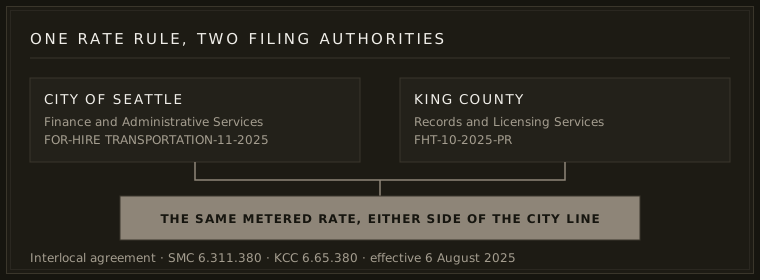
The authorities
Who sets Seattle taxi fares: two jurisdictions, one rule
Below the two authorities sit the dispatch agencies, which is where almost every duty about price actually lands.
One term is worth fixing before anything else, because the rule rests on it. The body that affiliates vehicles, chooses which rate type prices a trip and answers for the fare is a regional dispatch agency – an RDA, or during the transition a TRDA. It is not the driver, and the rule never leaves these choices to one. Where these pages say dispatch agency, that is the body meant.
Seattle taxi regulations are not issued by one body. For-hire passenger transport in this region is regulated cooperatively by the City of Seattle and King County under an interlocal agreement. The two do not publish competing tariffs; they file the same document separately: the current fares rule is Director’s Rule FOR-HIRE TRANSPORTATION-11-2025 on the city side and Public Rule FHT-10-2025-PR on the county side. It was published on 6 June 2025, took effect on 6 August 2025, and repealed both the 2024 county rule and Seattle Clerk File 323198.
The rate rule takes its force from statute. Rulemaking authority sits in SMC 6.311.470 for the city and KCC 6.65.470 for the county, with the substantive fare provisions at SMC 6.311.380 and KCC 6.65.380. The sponsoring agency on the county side is the Records and Licensing Services Division; on the city side it is the Department of Finance and Administrative Services. What the rule sets out is the metered rate itself.
A note on citations, because it trips people up. Older documents refer to King County Code chapter 6.64 for taxi matters. The current rule cites chapter 6.65. The chapter was renumbered, and a source quoting 6.64 is not necessarily wrong, only old.
Equipment
What the meter has to do under Seattle taxi regulations
The core equipment requirement in Seattle taxi regulations is short. A fare must be computed by a smart taximeter unless the trip runs under one of the alternative rate types the rule authorises or is dispatched through an approved application dispatch system. That requirement holds regardless of how the passenger obtained the vehicle: hailing on the street, telephoning, and booking through an app all land in the same place.
Meters have to be tested and approved by the Director under a separate rule on taximeters and smart taximeters, which sits alongside the rate rule. Where an alternative rate is used, the meter is still programmed to display the price charged for that trip from activation to completion, so the metered value of a flat-rated airport trip is recorded even though it is not what the passenger pays.
Advance presentation
Any alternative to the regional meter rate must be shown to the passenger before the trip is confirmed. The rule calls this advance presentation, and it is what turns a flat rate or a dynamic rate from a surprise into an offer. The asymmetry is deliberate: a passenger given an up-front fare with no other alternative rate in force may decline it and ask for the meter, but where an alternative rate has been properly presented, the passenger may decline the trip, but not the rate.
What changed
Licensing changed in March 2026: the for-hire category ended
Until recently the region ran two parallel categories: taxicabs, which metered, and for-hire vehicles, which charged from a rate book kept in the car. The rule closed that split. After 31 March 2026 all for-hire vehicles were required to have transitioned to taxicabs and to operate under the regional taximeter rate and the alternative rates that accompany it. The same date ended the allowance for a conventional taximeter in place of a smart one.
Descriptions of Seattle ground transport written before that date still distinguish between the two, and the distinction no longer corresponds to anything a passenger will meet. The rate book, the hourly rate and the flat-rate-by-zone pricing that characterised for-hire vehicles survive as options a dispatch agency may choose, not as a separate licence class.
Limits on charging
What a driver may not charge
Several prohibitions run through Seattle taxi regulations and they are worth reading as a set, because each one closes a gap the others leave open.
- A driver may not ask, demand or collect any rate other than the one the dispatch agency established. Rate-setting is a company function, not a driver function.
- Additional charges for transporting a person with a disability are prohibited outright, unless the trip runs under a contract rate. Where rates vary by vehicle size, a large wheelchair-accessible vehicle carrying a wheelchair user and up to four other passengers is billed at the small-car rate.
- Discriminatory charges against a passenger in a protected class are prohibited under both codes.
- A convenience fee for electronic payment may not be applied to a fare paid in cash or by voucher, and exists only where the Director has authorised it at the company’s written request, for the whole fleet.
- A company using the regional rate may not add a fuel surcharge of its own; only the one the Director authorises applies, and never to a contract-rate trip.
The transparency requirement points the other way as well: a company has to tell its own drivers what the fare was on each trip, whatever rate type priced it. What a passenger can do when one of these limits is breached starts from the receipt.
What survived the transition
Rate books, hourly prices and the rules that outlived the for-hire licence

The for-hire category is gone, and the pricing instruments that characterised it were folded into the list a dispatch agency may now choose from. They are worth setting out, because a passenger meets them more often than the regional meter rate in some parts of the county.
- Flat rate by address. A fixed charge between two specific addresses, the rule’s own example being Colman Dock to Seattle-Tacoma International.
- Flat rate by zone. A fixed charge by zone, with boundaries drawn on ZIP codes, covering every ZIP code in the served area and including a price for trips inside a single zone.
- Contract rate. Prices under written contract with a business or a non-profit, where the amount paid for the service is specified in advance.
- Hourly rate. Priced by the hour with a minimum increment of half an hour, and permitted to vary by time of day.
Two obligations run underneath all four. Prices had to be kept current and produced for inspection on the Director’s request, and they had to be reviewable by the passenger in a rate book carried conspicuously in the vehicle, on paper or on a tablet in the back seat. Where an hourly or zone price varied with the time of day, the variable version had to be clearly marked and easy to tell apart from the standard one. A driver could not ask for, demand or collect any price other than the one the company had established, which is the same limit that applies to metered work.
Fees the Director has to authorise
Two per-trip fees exist only on the Director’s approval, and only at the written request of the dispatch agency. A technology fee offsets the cost of obtaining and maintaining a smart meter system, covering software licensing, the equipment the system needs, wireless data and hardware repair. A convenience fee covers electronic payment and stands in place of the merchant fees the company or driver would otherwise carry. Both apply across an entire fleet or not at all, which removes the possibility of a fee that appears on one trip and not the next. Where they apply, they land on the metered fare as separate lines.
What the regulator watches
The rule builds in its own review. A dispatch agency has to tell each of its drivers what the fare was on every trip, whatever rate type priced it, so the person driving is not the last to know. The Director may periodically request data on total fares under two scenarios, one where the regional meter rate priced the trip and one where an alternative rate did, in order to compare them. And the Director undertakes to review the data periodically and to consult licensees, including drivers, on how often fares vary from the regional rate and which alternative types are being used. The rate structure described on the valley pages and in the city is meant to be revisited on evidence, not left to stand indefinitely.
Questions
Questions about Seattle taxi regulations
Who sets taxi fares in Seattle?
The City of Seattle and King County together, through a joint rule filed by both. The current one is FOR-HIRE TRANSPORTATION-11-2025 and FHT-10-2025-PR, effective 6 August 2025. Individual companies choose among the alternative rate types the rule authorises but cannot alter the regional meter rate.
Is a Seattle taxi obliged to use the meter?
Unless the trip runs on one of the authorised alternative rates or through an approved dispatch app, yes. And even on an alternative rate the meter is programmed to record the metered value of the trip.
What happened to for-hire vehicles?
The category ended on 31 March 2026. Every for-hire vehicle transitioned to taxicab status and to the regional meter rate.
Should I look at King County Code 6.64 or 6.65?
6.65. The chapter was renumbered, and the current rule cites 6.65 throughout. A reference to the older chapter is a historical citation.