The entities
What a TRDA and an RDA are
A taxicab regional dispatch agency and a regional dispatch agency are the licensed intermediaries between a fleet and its passengers. They affiliate vehicles and drivers, they hold whatever contracts exist with businesses and public bodies, and in the language of the rule they are the party that establishes rates.
That last point is stated without hedging: “the TRDA or RDA determines the alternate rate or fare type, not the individual driver”. Everything downstream follows from it. A driver applies a rate and cannot originate one, and the rule forecloses the obvious workaround by adding that drivers “may not ask, demand, or collect any rate other than the rate established by the TRDA or RDA”.
The technical work is delegated again, this time to a supplier. An alternate rate “must be programmed into the smart taximeter system by the vendor of the smart taximeter system and/or the RDA; the programming shall enable Advance Presentation”. The capacity to show a passenger a price beforehand is built into the equipment by contract, not improvised per trip.
The duties
What the rule makes an agency do
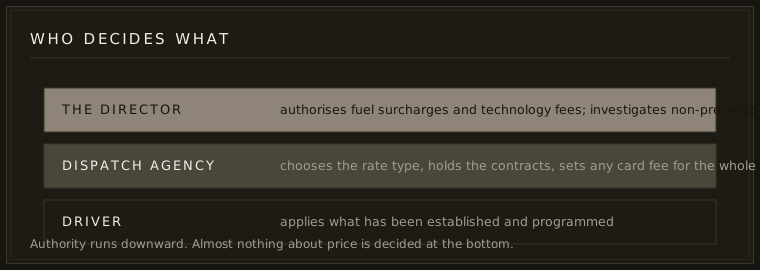
Several obligations that a passenger experiences as a driver’s behaviour are in fact the agency’s. Fuel surcharge notices are issued by the Director to each agency, and it is the agency’s responsibility that they end up on the dashboard of every affiliated vehicle, visible to passengers, and are returned when the surcharge changes.
A card convenience fee, likewise, is an agency-level arrangement: the rule has it applied across the whole of the agency’s vehicles, by the agency together with its electronic payment processor. A technology fee requires the Director’s authorisation and is granted “only at the written request of the regional dispatch agency”. Neither is a per-driver option.
One duty runs inward rather than outward, and it is easy to overlook. The agency “shall make known to the affiliated regional for-hire driver the amount of the fare for each trip by that driver regardless of the rate or fare type used to price the trip”. Where a trip is priced by a flat rate or a dynamic rate, the driver is entitled to know what it produced.
Above the agency
What the Director keeps for the regulator
Above the agencies sits the Director, and the powers reserved there are the ones that would otherwise be open to abuse. Fuel surcharges are authorised by the Director against an external price index and a fourteen-day test. Technology fees are authorised by the Director. Complaints about a price not being presented before a trip was confirmed are investigated by the Director.
The rule also reserves an information-gathering power that is unusual in a fare schedule: the Director may request data on total fares under two scenarios, one metered and one on an alternate rate, “to see how the total fares compare”. That is a deliberate check on the freedom the alternate rate types create, and it works because the meter keeps recording a price even when the passenger pays something else.
Which Director, in practice, depends on the vehicle. The rule is issued jointly by the City of Seattle’s Department of Finance and Administrative Services and King County’s Records and Licensing Services Division, and the licence determines which of them a matter belongs to.
Questions
Questions about dispatch agencies
Can I negotiate a fare with the driver?
No. The rate type is determined by the dispatch agency, and drivers may not ask, demand or collect any rate other than the established one. The permitted types are named in the rule.
Who decides whether there is a card fee?
The dispatch agency, together with its payment processor, and it must cover the whole operation rather than being applied trip by trip. Cash and voucher payments may not be assessed one at all.
Does the driver know what a flat-rate trip earned?
The agency is required to make the fare amount known to the affiliated driver for each trip, whatever rate type was used to price it.
What does the Director actually control?
Fuel surcharge authorisation and removal, technology fee authorisation, investigation of complaints about prices not being presented in advance, and the power to request fare data comparing metered and alternate pricing.