The checks
Three things to establish before calling it an overcharge
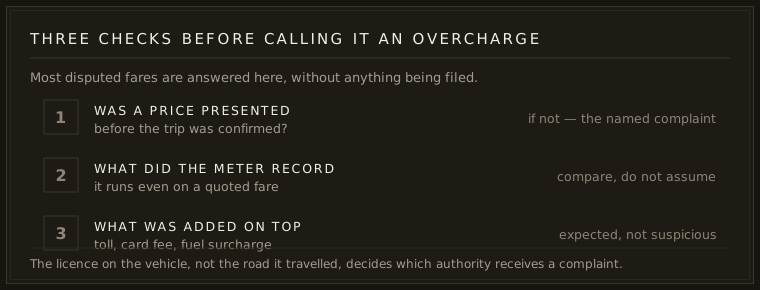
The first is whether the trip was priced on the meter at all. A dispatch agency may run flat rates, contract rates, dynamic rates or an upfront fare, and a price that does not match the meter is not evidence of anything by itself. What the rule requires is that such a price was put in front of the passenger beforehand.
The second is the meter figure, which exists even when it is not what you paid. The rule requires the taximeter to display the rate or fare charged from activation to completion, and notes that the programming “allows for the price of the metered trip to be recorded while the alternate rate or fare is used to determine what the passenger pays”. A metered number is therefore generated on every trip, whatever pricing was applied on top.
The third is what sits above the fare. Tolls are not required to appear on the meter but may be added to the total; a card convenience fee may exist if the fleet applies one; a fuel surcharge may be in force, in which case a notice should be on the dashboard. A total above the meter reading is expected rather than suspicious.
The named complaint
The one failure the rule singles out
Among everything a passenger might object to, the rule names one specifically. The Director “will investigate any passenger complaints about not being presented a trip rate, fare, or price for consideration before confirming a trip”.
That is a procedural complaint, not a pricing one, and it is much easier to establish. It does not require showing that a fare was unreasonable. It requires showing that the price arrived too late to be considered — after the trip was under way, or at the end.
It is worth pairing with the rule about who may set a price at all. A driver cannot introduce a rate: the dispatch agency determines the type, the vendor programmes it into the meter, and “for-hire drivers may not ask, demand, or collect any rate other than the rate established by the TRDA or RDA”. A figure produced at the kerb that belongs to no established type is not a negotiation.
Where it goes
Which authority receives the complaint
Seattle and King County regulate for-hire transport together and publish one joint rate rule, but they remain two licensing authorities. Vehicles operating inside the city are licensed by the city’s Department of Finance and Administrative Services; vehicles in unincorporated areas are licensed by King County Records and Licensing Services.
The licence follows the vehicle, not the journey. A trip that crosses the line does not change hands partway, so the question to answer is which authority licensed the cab you were in — which is another reason the receipt matters more than the memory of the trip.
The regulator also looks at the aggregate, independently of any complaint. The rule allows the Director to request data on total fares under two scenarios, one metered and one on an alternate rate, “to see how the total fares compare”. A single passenger cannot run that comparison; the point of recording the metered figure on every trip is that someone can.
Questions
Questions about disputed fares
The fare was more than the meter showed. Is that allowed?
Usually yes. Tolls incurred while you were being carried may be added without appearing on the meter, and a card convenience fee or an authorised technology fee may also apply.
I was quoted a price and never shown how it was calculated. Is that a complaint?
Only if it was not presented before you confirmed the trip. The rule requires advance presentation, and the Director investigates complaints about a price not being presented for consideration beforehand. It does not require the calculation to be explained.
Can I refuse to pay a fare I think is wrong?
That is not what the rule addresses. It governs what may be charged and how prices must be presented, and it routes disputes to the licensing authority rather than settling them at the kerb.
Who licensed my cab?
The receipt identifies the vehicle, and the vehicle’s licence determines the authority: the City of Seattle inside city limits, King County in unincorporated areas.