

The fare
Renton taxi fares: what the meter charges
Renton taxi fares are the regional meter and nothing else: $2.60 on entering, $2.70 a mile above eleven miles an hour, $0.50 a minute below it, and fifty cents for each passenger beyond two who is twelve or older. Those figures come from the same joint rule that governs Seattle, because the city and the county issue one document between them.
The consequence is that a Renton taxi crossing into Seattle does not change rate partway. What can change is who a complaint goes to, since the licensing authority follows the vehicle, not the road it happens to be on.
Two practical points follow from a shared tariff. The first is that comparing companies on price is not useful here in the way it is in a deregulated market: on the regional meter there is nothing to compare, and the differences that matter are availability, vehicle condition and how a company handles a problem afterwards. The second is that a quoted price which differs from the meter is not automatically wrong. A company may price a trip flat, by contract, up front, or on a schedule of its own, and any of those is legitimate provided it was presented before the trip was confirmed.
The extra-passenger charge behaves the same way in the valley as in the city: fifty cents for each person beyond two, with children under twelve not counted at all. So does the prohibition on charging more to carry a passenger with a disability, and so does the rule that a large wheelchair-accessible vehicle carrying a wheelchair user and up to four others must be billed at the small-car rate.
- Drop
- $2.60identical to the Seattle rate
- Per mile
- $2.70set by the same joint rule
Licensing
Why Renton cabs fall under county licensing
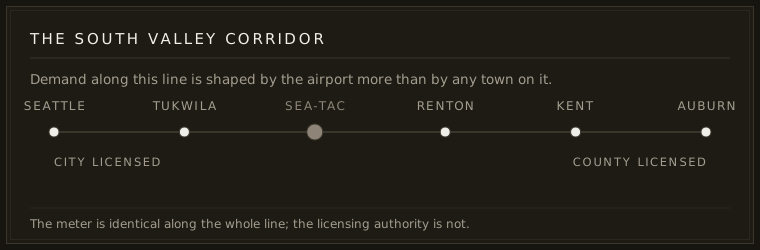
King County and the City of Seattle regulate for-hire transport cooperatively under an interlocal agreement, but they remain separate licensing authorities. Renton cabs are licensed by the county side of that arrangement. Vehicles operating in Renton and the surrounding unincorporated areas are licensed by King County Records and Licensing Services; vehicles operating inside Seattle city limits are licensed by the city’s Department of Finance and Administrative Services.
For a passenger this is invisible until something needs resolving. The rate is shared, the vehicle standards are shared, and the rate rule carries both a city number and a county number on its cover page. Where it stops being invisible is a complaint, a lost-property claim or a dispute over a fare, because those go to whichever authority licensed the vehicle.
The pick-up asymmetry visitors notice has the same root. A vehicle’s licence determines where it may accept a hail, so a cab that dropped a passenger somewhere is not automatically entitled to pick one up there for the return.
Airport proximity
The south valley, the cabs and the Sea-Tac corridor
Renton, Tukwila, SeaTac, Kent and Auburn form a south valley corridor whose demand for cabs is shaped by the airport more than by any of the towns in it. That works two ways. Availability is better than a suburb of comparable size would suggest, because vehicles are already circulating for airport work. It is also less predictable, because a vehicle in the queue for a departing airport trip is not a vehicle available for a local one.
A Renton taxi trip from Sea-Tac is subject to the twenty-dollar departure minimum like any other trip leaving the airport, even though the distance is short. The reverse trip is metered normally. The Sea-Tac page sets out how that asymmetry works.
That asymmetry has a visible effect on short south valley journeys. A run of two or three miles from the airport into Tukwila or Renton will usually meter below twenty dollars and therefore land on the minimum, while the identical journey in the other direction is priced on the meter alone. Passengers who make the trip regularly in both directions notice the gap before they can explain it.
Beyond the meter
Zone, hourly and contract pricing on a Renton taxi

The regional meter rate is the same in Renton as in Seattle, and the alternatives a dispatch agency may run alongside it are the ones that most often change what a valley trip costs. Zone pricing is the clearest case: a flat charge by zone uses ZIP-code boundaries, covers every ZIP code in the area a company serves, and includes a price for a trip that starts and ends inside the same zone. A journey across two or three valley ZIP codes can therefore be priced without the meter deciding anything.
Hourly pricing exists for the trips that are not really point-to-point, with a minimum increment of half an hour, and it may vary by time of day. So may zone rates. Where they do, the rule requires the variable prices to be clearly marked and kept distinct from the standard ones, so a passenger is not left comparing a daytime figure against an evening charge. Contract pricing covers the standing arrangements a company holds with a business or a non-profit, and those trips sit outside the fuel surcharge entirely.
The document that made these prices checkable in a for-hire vehicle was the rate book: kept current, placed conspicuously in the car, on paper or on a tablet in the back, and available for inspection by the Director on request. Drivers could not ask for anything other than the price their company had established. Since the March 2026 transition ended the for-hire category, the rate book travels with the rate types that survived it, alongside the regional meter rate that now governs every licensed vehicle in the valley.
Questions
Renton taxi questions
Are Renton cab fares cheaper than Seattle’s?
No. The metered rate is identical, because Seattle and King County publish one joint rate rule. Individual trips differ in cost because of distance and traffic, not because of a different tariff.
Can a Seattle-licensed cab pick me up in Renton?
Not necessarily. A vehicle’s licence determines where it may accept a passenger, which is why a cab that has just dropped someone off cannot always take a return fare from the same spot.
Who handles a complaint about a Renton taxi?
King County Records and Licensing Services, which licenses vehicles operating in unincorporated areas; the City of Seattle does not. The receipt identifies the vehicle, which is what any such claim starts from.
Why did my short trip from the airport into Renton cost twenty dollars?
Because a $20 minimum applies to every trip originating at Sea-Tac, however short. The meter runs anyway, and whichever is higher – the metered fare or the minimum – is what you pay. The same journey toward the airport carries no minimum.