
.jpg)
Before you get out
Why the taxi receipt is the whole game

A receipt is not a formality here. It is the record that ties a person to a specific vehicle at a specific time, and without it a lost-property claim, a fare dispute and a complaint all begin from nothing. Take one on every trip, including the trips where nothing seems likely to go wrong, because the trips where something goes wrong are not announced in advance.
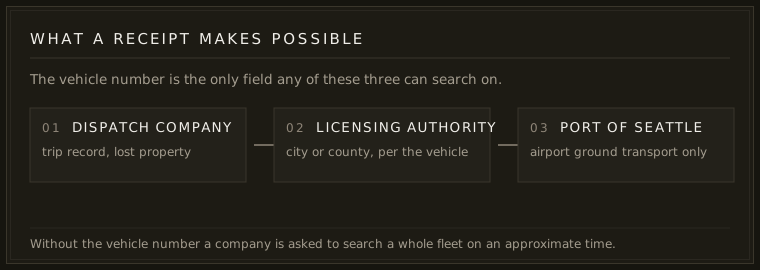
The item to check for is the vehicle identifier, whatever rate priced the trip. A dispatcher searching for a phone left on a back seat is searching a fleet by number or the route. Time and date narrow it; the number finds it.
Where a trip was priced by an up-front or alternative fare, the receipt matters for a second reason: it records what was actually charged as against what the meter recorded, and those are deliberately allowed to differ.
Afterwards
Something left in the cab
Work outward from the narrowest source. The dispatch agency that operated the vehicle is the first call, and the vehicle number from the receipt is what makes that call productive. Without a number, the honest description of the problem is that a company is being asked to search its whole fleet on the strength of an approximate time.
Where the vehicle was licensed determines who else can help. A vehicle licensed by the City of Seattle and one licensed by King County answer to different authorities even though they run the same meter, so the licensing body on the receipt is the second address to try.
Card payment leaves a trace that cash does not, which is worth remembering when the receipt has gone missing too. A card statement will not identify a vehicle, but it will pin the company and the time.
Payment
Paying by card, and the fee that is not a surcharge
The commonly repeated line is that Seattle cabs cannot charge for card payment. That overstates a rule that is more specific and more useful than the summary. A convenience fee for electronic payment exists as a regulated instrument: it must be requested in writing by the dispatch agency, authorised by the Director, applied across the entire fleet and never at a driver’s option, and set in place of the merchant fees the processor would otherwise charge the company.
What is genuinely prohibited is applying that fee to a fare settled in cash or by voucher. A charge that appears only because a card came out, decided by the driver at the end of the trip, is not the authorised instrument.
Tolls
Bridge, tunnel, road and ferry charges incurred while a passenger is aboard can be added to the total, and they do not have to appear on the meter. The exception is the useful part: where the fare was presented and agreed before the trip started, a toll cannot be added afterwards.
Fuel surcharge
When one is in force, a printed notice on the dashboard states the amount. That notice is the reliable source, because the surcharge switches on and off with pump prices over fourteen-day windows instead of sitting at a fixed value.
Accessible service
Wheelchair-accessible taxis and what may not be charged
The pricing rules for accessible trips are set out in full separately.
Charging extra to transport a passenger with a disability is prohibited unless the trip runs under a negotiated contract rate. That is the plain rule, and the interesting part is the provision that stops it being circumvented by vehicle class. A company is allowed to price by vehicle size, but when a large vehicle that is also wheelchair accessible carries a wheelchair user and up to four other passengers, the small-car rate must apply. Only at five or more additional passengers does the large-car rate come back. Raising a charge that breaches this starts with the company on the receipt.
The ordinary extra-passenger charge still applies once there are more than two people aboard, counting adults and children of twelve and over.
One cost is invisible because it is folded in: accessibility is funded inside the drop rate rather than listed as a separate line, so it never appears on a receipt as its own item.
Sharing a trip
Splitting a fare, and what each receipt has to show
A dispatch agency may offer a split fare, and the arithmetic is set out rather than left to the car. The trip cost is divided equally among the passengers who accept the invitation to split. Where pick-up or destination points differ, it is divided proportionately instead. A company may charge an additional fee for each portion of a split.
The receipt requirement is the part worth knowing before the trip ends: it has to indicate the total fare paid by each passenger for that passenger’s portion. Four people leaving a restaurant in four directions should end up with four documents that each stand on their own, and a single receipt for the whole car does not satisfy the rule.
When the price quoted is not the price charged
An alternative price has to be shown before a trip is confirmed. If it was not, that is a specific complaint with a specific home: the Director investigates complaints about not being presented a rate, fare or price for consideration before the trip was confirmed, as well as complaints about the prices themselves. Where a plain up-front fare was quoted and no other alternative rate was running, a passenger may decline it in the moment and ask for the meter instead, which is easier than contesting it afterwards. Once a trip is under way and a stop is added, the fare is either recalculated by the meter or reverts to the posted meter rates from the point the trip began. The rate that priced your trip appears on the fare breakdown as one of a fixed list, and naming it is the fastest way to make a complaint legible.
Questions
Practical questions
What should a Seattle taxi receipt show?
The detail that matters most is the vehicle identifier, because that is what a dispatcher searches when something is left behind. Date, time and the fare charged narrow a search; the vehicle number completes it.
I left something in a cab. Who do I call first?
The dispatch agency that operated the vehicle, with the vehicle number from the receipt. The licensing authority shown on the receipt is the second call, and which one that is depends on whether the vehicle was licensed by the city or the county.
Can I be charged a fee for paying by card?
Only where an authorised convenience fee is in force across the whole fleet, requested in writing by the company and approved by the Director. It cannot be applied to cash or voucher payments, and a driver cannot decide to add one.
Does a wheelchair-accessible taxi cost more?
No. Additional charges for transporting a passenger with a disability are prohibited outside a contract rate, and a large accessible vehicle carrying a wheelchair user plus up to four others must be billed at the small-car rate.