The prohibition
No special rate for carrying a disabled passenger
The rule states it as a prohibition rather than a principle: “unless part of a contract rate, establishing special vehicle service rates or additional charges for the transport of persons with disabilities is prohibited”.
Read closely, it forbids two distinct things. A special rate — a separate tariff applied because of who is travelling — and a special charge added on top of an ordinary tariff. Neither survives. A loading fee, an equipment fee or a longer-boarding fee would fall on the wrong side of that sentence however it were labelled.
The carve-out is narrow and specific: a contract rate, meaning a price agreed in writing between a dispatch agency and a business, a non-profit or a government body. Those arrangements exist for paratransit and similar programmes, where the payer is usually not the passenger. Outside that, the position is flat.
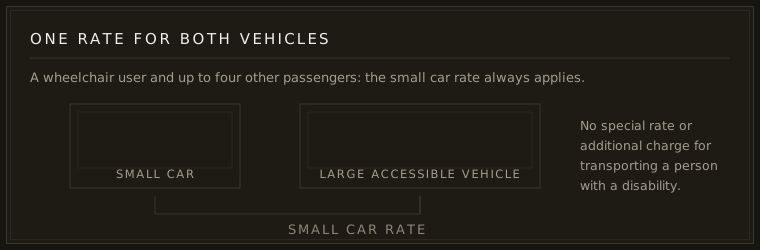
The override
When a large vehicle is billed as a small one
The second sentence does more work than its length suggests: “when a large vehicle that is also a wheelchair accessible vehicle transports a passenger in a wheelchair and up to four additional passengers, the small car rate shall always apply”.
Ordinarily vehicle size can move a fare. Here it cannot. The conditions are precise — the vehicle is both large and wheelchair accessible, it is carrying a passenger in a wheelchair, and the rest of the party is four people or fewer — and when they hold, the rate is the small car rate regardless.
- Passengers besides the wheelchair user
- up to 4the ceiling for this rule
- Rate applied
- small car“shall always apply”
The word always is unusual in a rate schedule and worth noticing. It leaves no room for a busy-period exception or an agency policy to the contrary.
What still applies
Everything else works the way it normally does
These provisions govern price, not service, and they sit on top of the ordinary structure rather than replacing it. The trip is still metered on the regional rate, the extra-passenger charge still counts people beyond two and still excludes children under twelve, and a trip beginning at the airport still meets its minimum.
Quoted prices behave normally too. If an agency uses an alternate rate type, it must be presented before the trip is confirmed, and the prohibition on disability-related charges applies to what is presented just as it does to a meter reading. A quoted price that is higher because of the passenger’s equipment is the thing the rule forbids, whatever mechanism produced it.
Where a charge does look wrong, the route is the ordinary one: the receipt identifies the vehicle, and the vehicle’s licence determines which of the two authorities receives the complaint.
The limits of the document
What the rate rule does not settle
It is worth being precise about the reach of these two sentences, because a rate rule is a narrow instrument. It governs what may be charged. It does not govern how many accessible vehicles a dispatch agency runs, how long one takes to arrive, or how a booking is prioritised. Those questions live in licensing and in agency practice, not in the schedule of fares.
Nor does the rule create a right to an accessible vehicle on demand. What it does is remove price as a barrier once one is provided: the trip cannot be surcharged for the passenger’s disability, and the larger vehicle cannot be billed as a larger vehicle when it is carrying a wheelchair user and a small party.
That distinction matters when deciding where to take a problem. A fare that looks wrong is a rate question and belongs with the licensing authority. A vehicle that never came is a service question, and the same authority licenses the agency, but the two complaints rest on different parts of the framework.
Questions
Questions about accessible taxi fares
Can a company charge more for a wheelchair accessible vehicle?
Not for transporting a person with a disability. Establishing special vehicle service rates or additional charges for that is prohibited unless it forms part of a contract rate.
A van came instead of a car. Do I pay the van rate?
If it is a large wheelchair accessible vehicle carrying a wheelchair user and up to four other passengers, the small car rate always applies.
Does the extra passenger charge still apply?
Yes. Fifty cents for each person beyond two, with children under twelve not counted. That charge is about the number of passengers and is unaffected by these provisions.
What counts as a contract rate here?
A rate established under a contract between a dispatch agency and a business, a non-profit organisation or a government entity, where the amount paid for the service is specified in the agreement.