
The rule
The $20 minimum on a Seattle airport taxi leaving Sea-Tac
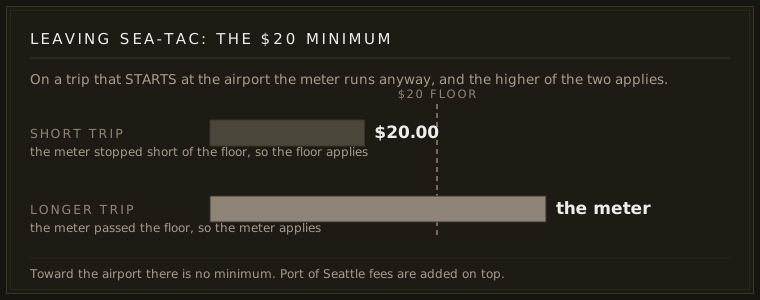
A Seattle airport taxi is priced like any other metered trip in one direction and unlike one in the other. Any taxi trip originating at Sea-Tac carries a minimum fare of twenty dollars, exclusive of fees, surcharges and tolls. The driver must start the meter on every departing trip whatever the destination, and the comparison happens on arrival: if the metered fare came in under twenty, the minimum applies; if it came in above, the meter stands. A short run to a hotel on International Boulevard therefore costs the same as a considerably longer one, which surprises people who expect the meter to be the whole story.
The minimum is set by King County under KCC 6.65.380.D, and drivers are required to post a notice provided by the county telling passengers it exists. Where a vehicle runs a smart taximeter, the notice may live on the passenger-facing screen instead of on paper.
The minimum fare is a departure rule. A trip toward the airport is an ordinary metered trip with no floor under it, so the fare into Sea-Tac and the fare out of Sea-Tac are not symmetrical even over the same road – something regular travellers to Renton and the valley notice quickly.
The number everyone quotes
The downtown flat rate that no Seattle airport taxi rule establishes
Search for the cost of a cab between downtown and Sea-Tac and a figure around forty dollars comes back with the confidence of a published tariff. It is not one. The joint city and county rule addresses the point directly and disposes of it in a sentence: it “does not establish any flat rate between downtown Seattle and Seattle-Tacoma International Airport (SEA) or between Seattle-Tacoma International Airport (SEA) and downtown Seattle. If desired, a TRDA or RDA may establish such a rate(s).”
That leaves the decision with the dispatch agencies. One may run a flat rate to the downtown core, another may meter the same trip, and a third may quote an up-front fare calculated from the smart meter’s own estimate. All three are legitimate. What the rule requires in every case is that the price be presented before the trip is confirmed, so the question to ask on the rank is not “what is the flat rate” but “is this trip flat-rated, and at what.”
Where a flat rate does apply, it behaves differently from the meter in one respect worth knowing: a fare presented and accepted before departure cannot have tolls added to it afterwards.
On top of the fare
Port of Seattle fees, and what else lands on the airport fares
A Seattle airport taxi picks up under Port of Seattle rules as well as county ones, and the Port assesses a fee on commercial trips originating at the airport. Where the Port permits it to be passed along, that portion is added to the minimum fare, not absorbed into it, which is why an airport receipt usually carries a line a downtown receipt does not.
The regional charges still apply on top of the meter in the ordinary way: tolls incurred while a passenger is aboard, an electronic payment convenience fee where one has been authorised across an operator’s whole fleet, and the temporary fuel surcharge when pump prices have held above a trigger for fourteen days. None of those are airport-specific. The rate breakdown sets out how each behaves.
The Port of Seattle sets its own commercial ground transportation fees and publishes the current position of the rank; both move independently of the regional rate rule, so the Port is the authority for either figure.
On the ground
Finding a taxi at Sea-Tac
The Seattle airport taxi rank is not at the arrivals kerb. Passengers cross from the terminal into the parking garage and find the ranks on an upper floor, which catches out anyone expecting the taxi line to be the first thing outside the door. Signage inside the terminal points to it, and the walk is longer with luggage than the map suggests.
Two questions are worth settling before the vehicle moves. Whether the trip is running on the meter or on an alternative rate, because the answer determines whether tolls can be added later. And whether a fuel surcharge is currently in force, which the dashboard notice answers directly.
Accessible vehicles
Charging extra to carry a passenger with a disability is prohibited outright unless the trip runs under a contract rate. Where a company prices by vehicle size, a large wheelchair-accessible vehicle carrying a wheelchair user and up to four other passengers must be billed at the small-car rate.
How it works in the car
How the Sea-Tac minimum fare is applied inside the vehicle

The twenty-dollar figure is the outcome, and the mechanics behind it decide what a receipt for a short airport run looks like. The driver must start the meter for every trip departing the airport whatever the destination, so a two-mile journey is metered normally and then brought up to the minimum. That is the reason a short hop and a slightly longer one can produce the same number.
Where the vehicle runs a smart meter, the rule allows the minimum to be configured as a flat rate of its own, which the driver engages by selecting it at the start of the trip. Under the older equipment the minimum was applied to a conventional metered fare instead. That second path closed with the March 2026 transition, when the separate for-hire category ended and the licensing change put every vehicle on the same footing.
Tolls, and the one case where they cannot be added
Tolls and charges for roads, bridges, tunnels and ferries incurred while a passenger is aboard are not required to appear on the meter, and may be added to the total. The exception matters on precisely this route: where the fare was presented to the passenger before the trip began, tolls may not be added afterwards. A quoted airport price is meant to be the finished number, and an up-front fare has to include estimated surcharges, tolls and fees when it is quoted. Any Port of Seattle fee charged for trips originating at the airport is passed through in the same way, and shows on the receipt as its own line.
Questions
Sea-Tac taxi questions
Is there a fixed price from Sea-Tac to downtown Seattle?
Not one set by rule. The regional rule explicitly establishes no flat rate in either direction and leaves it to individual dispatch agencies. If a company applies one, it has to be shown to you before you confirm the trip.
Why was my short trip from the airport still twenty dollars?
Because a $20 minimum applies to any trip originating at Sea-Tac. The meter runs regardless, and the higher of the metered fare and the minimum is what you pay.
Does the minimum apply going to the airport as well?
No. It applies only to trips that start at the airport. A trip into Sea-Tac is metered normally.
What is the extra charge on my airport receipt?
Most often the portion of the Port of Seattle’s commercial ground transportation fee that the Port allows to be passed to the passenger. It sits on top of the minimum fare.