The requirement
What advance presentation actually means
The rule gives the term a definition rather than leaving it to custom. Advance presentation is where an “agency presents a taxicab rate, fare, or price to a passenger so that the passenger can consider it before deciding whether to confirm the trip”. The load-bearing phrase is before deciding whether to confirm. A price delivered at the kerb once the bags are in is not a presentation in this sense.
It is not optional for anything other than the plain meter. Advance presentation “is required for any alternate rate or fare type established and used by the TRDA or RDA”, which covers flat rates, contract rates, dynamic rates and the rest. Whenever a Seattle or King County cab intends to charge something other than the regional meter, the passenger is entitled to see that something first.
Enforcement sits with the Director, and it is specific about the failure mode rather than about price. The Director “will investigate any passenger complaints about not being presented a trip rate, fare, or price for consideration before confirming a trip”. The complaint that carries weight is therefore not this was expensive but this was never shown to me.
The split
One quoted fare you can refuse, and several you cannot
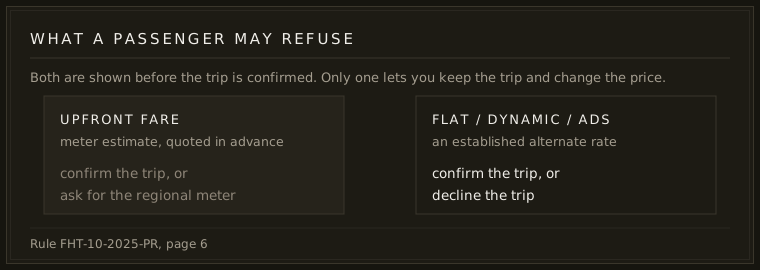
Here the rule draws a line that is easy to miss and useful to know. For an upfront fare, and only where other alternate rates are not in place, “a passenger may reject the fare and ask the driver to apply the regional taximeter rates to the trip instead”. The trip survives; the pricing method changes.
For the other types the position reverses. Where a rate requires advance presentation — a flat rate, a dynamic rate, an automated driving system rate — “a passenger may reject or confirm the trip but may not reject the rate or fare”. The choice is to travel on those terms or not to travel.
- Upfront fare
- refusablethe meter is the fallback
- Flat, dynamic, ADS
- take or leavethe trip is the only choice
Knowing which one is on offer is therefore worth a question before the doors close. An upfront fare has a defined construction: it is built from the estimated time and distance the smart taximeter calculates, multiplied by the regional rate, and it must include estimated surcharges, tolls and fees, be confirmed before the trip begins, and be the final charge at the end. Tips and electronic payment convenience fees sit outside it.
Mid-trip
What happens when the destination changes
A quoted price is a quote for a described journey, so the rule has to say what becomes of it when the journey changes. If a passenger changes the destination or adds stops after the trip has begun, the driver “may update the destination in the smart taximeter for the taximeter to provide an updated fare”. Where the meter has been configured with a fallback rate instead, “the trip shall revert to the posted meter rate(s) displayed from the point at which the trip began”.
Two different outcomes, then, and which one applies depends on how the vehicle was configured rather than on anything decided in the moment. Asking for an extra stop can turn a fixed price into a metered one.
Underneath all of this the meter keeps running regardless. The rule requires that the taximeter “be programmed to display from the time the trip is activated to the time the trip is completed the rate or fare charged to the passenger”, and notes that this “allows for the price of the metered trip to be recorded while the alternate rate or fare is used to determine what the passenger pays”. A flat-rate trip still generates a metered figure in the background — which is what makes comparison against the regional rate possible after the fact, and is also why the regulator can ask for that comparison across a fleet.
Questions
Questions about quoted fares
Can I ask for the meter instead of a quoted price?
For an upfront fare, yes, provided no other alternate rate is in place: you may reject it and ask the driver to apply the regional taximeter rates. For a flat, dynamic or ADS rate, no.
Does an upfront fare include tolls?
Yes. An upfront fare must include estimated surcharges, tolls and fees, and it is the final charge when the trip ends. On a metered trip tolls behave differently.
Is a tip part of the quoted price?
No. An upfront fare excludes tips, and it also excludes electronic payment convenience fees.
What if nobody showed me a price at all?
That is the complaint the rule names directly. The Director investigates complaints about not being presented a rate, fare or price before the trip was confirmed. Which authority receives it depends on who licensed the vehicle.