Tolls
Why a toll is missing from the meter and present on the bill
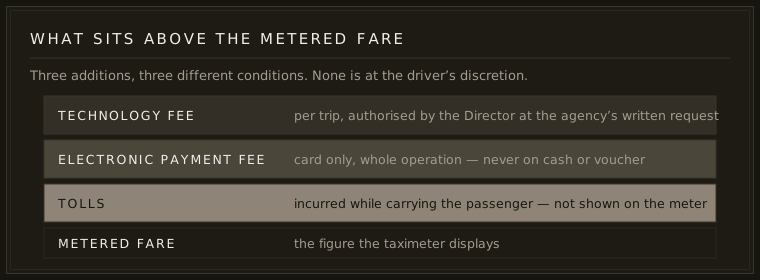
The rule is explicit that the display is not the whole story. Tolls or charges for “roads, bridges, tunnels, or ferries while a passenger is being transported are not required to be displayed on the smart taximeter or taximeter but may be added to the passenger’s total fare”.
Two conditions are packed into that sentence. The toll has to be incurred while the passenger is aboard, so a driver’s return crossing is not chargeable. And the permission ends where a quoted price begins: the exception is “when the fare was presented to the passenger before the trip began”. A price agreed in advance already accounts for tolls, so adding them again would be charging twice.
For a Seattle passenger this bites on a short list of crossings, and it is worth knowing before the trip rather than after. A route that uses a tolled tunnel or a bridge will produce a total above the meter, and the receipt is where that difference should be legible.
Paying by card
The electronic payment fee is permitted, and constrained
It is easy to read the card provision as a prohibition. It is not. It is an authorisation with conditions: where a trip fare is paid electronically, the rule has the fee applied across the whole of an agency’s vehicles, jointly by the agency and its electronic payment processor, and standing in lieu of additional merchant fees charged to the agency or the driver.
That scope is the operative constraint. A convenience fee is a decision taken once for an entire operation, not per driver and not per trip, and it replaces merchant fees rather than sitting on top of them. The prohibition that follows is narrow and absolute: “trip fares paid for by cash, voucher, or other payment method shall not be assessed a convenience fee”.
- Paid by card
- fee possibleonly across the whole operation
- Paid in cash or by voucher
- no feeprohibited outright
A convenience fee appearing on a cash payment is therefore not a grey area. Nor is one applied by a single driver where the rest of the operation charges nothing.
Technology fee
A fee that needs the Director’s authorisation
The third addition is the most tightly held. A technology fee is “a per trip fee authorized by the Director only at the written request of the regional dispatch agency”. Three constraints in one clause: it is per trip rather than proportional, it requires the Director to authorise it, and the Director acts only on a written request from the agency.
What none of these three additions has in common with the meter is discretion at the point of service. Tolls follow the route, the card fee follows an arrangement covering the whole operation, and the technology fee follows an authorisation on file. A passenger who sees an unexplained line item is looking at something that should be traceable to one of those, and a receipt is the document that makes it traceable.
Where a price was quoted in advance, the picture simplifies considerably. An upfront fare must already include estimated surcharges, tolls and fees and is the final charge when the trip ends, leaving only tips and the card convenience fee outside it.
Questions
Questions about additions to the fare
Why is the total higher than the meter reading?
Most often a toll. Tolls are not required to be displayed on the taximeter but may be added to the total when they were incurred while the passenger was being carried.
Can I be charged a card fee on a cash payment?
No. Fares paid by cash, voucher or any other method must not be assessed a convenience fee. The fee exists only for electronic payment and only where it covers the whole operation.
What is a technology fee?
A per-trip fee the Director may authorise, and only at the written request of the regional dispatch agency. It is not something a driver or a single company can introduce independently.
Are tolls added to a quoted price as well?
No. The permission to add tolls does not apply where the fare was presented to the passenger before the trip began, and an upfront fare is required to include estimated tolls already.