

Origins
The hire carriage, and the year it enters the record
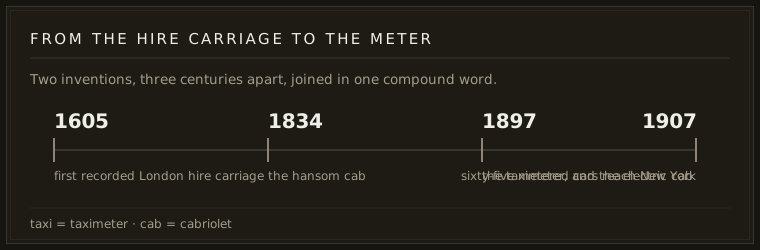
The first vehicles for hire were not cars. “Cab” is a contraction of cabriolet, a light horse-drawn carriage, and the practice of hiring one is documented in England and France from the seventeenth century. The oldest surviving mention of a hire carriage in London records a ride in 1605.
Parliament legalised and regulated carriages for hire not long afterwards, which is the first appearance of a pattern that has repeated in every city since: the trade grows, the pricing becomes contentious, and an authority steps in to set terms. The English contribution to the vehicle itself came in 1834 with the hansom cab, which needed one horse instead of two and was quicker for it.
The measuring device
1897, the year the taximeter and the electric cab both arrived
Three developments landed within months of each other. Walter Bersey put electric vehicles on London streets in 1897, and the fleet nicknamed the Hummingbirds began displacing hansom cabs. Electric hansom cabs appeared in New York in the same year. And German inventors – Wilhelm Friedrich Nedler, Ferdinand Dencker and Friedrich Wilhelm Gustav Bruhn – produced the taximeter.
The first taxicab fitted with one was the Daimler Victoria, built by Gottlieb Daimler, also in 1897. What the meter changed was not the journey but the argument at the end of it. A fare measured by a device is a fare neither party sets, and the passenger who cannot judge distance in an unfamiliar city stops being at a disadvantage.
The pattern repeats
Why every taxi trade ends up regulated
The same sequence has played out in city after city for four hundred years, and it is worth naming because it explains why a modern rate rule runs to ten pages. A trade in hire vehicles grows without much structure. Pricing becomes the point of friction, because the passenger cannot verify distance and the driver can. Complaints accumulate, an authority intervenes, and the intervention takes one of two forms: fix the price, or fix the measurement.
England chose to fix the price first, in the seventeenth century, and discovered what every jurisdiction since has discovered, which is that a fixed price is either too high for short trips or too low for long ones. The taximeter resolved the problem by fixing the measurement instead and letting the price follow from it. That is why the device spread faster than any particular tariff ever did.
What modern rules add on top is everything the meter cannot settle by itself: who may charge extra and for what, what happens at an airport, whether a company may quote a price up front instead, and which charges may never be applied at all. The measurement stayed simple; the questions around it did not.
Crossing over
How metered taxis reached the United States
Americans travelling in Europe met the metered cab as tourists and brought back an expectation, not a technology. Importers followed, and businessmen began bringing European taxicabs into American cities. New York’s decisive import came in 1907, when sixty-five French cars with taximeters arrived and were repainted yellow.
Very little about the arrangement has changed since. Vehicles improved, the meter went from mechanical to electronic to networked, and the regulatory apparatus around it grew from a few clauses to documents running to dozens of pages. The core transaction is the one Bruhn and his colleagues defined: a measured distance, a published rate, and a number neither the driver nor the passenger can argue with. Seattle’s current rate is a direct descendant, drop rate and all.
Questions
Questions about taxi origins
When is the first hire carriage recorded?
The oldest surviving mention of a carriage for hire in London records a ride in 1605. Parliament legalised and regulated the trade not long afterwards.
What was the hansom cab?
A lighter carriage introduced in England in 1834 that needed one horse instead of two, and was quicker for it. It defined the London street until electric and petrol vehicles displaced it around 1897.
Who invented the taximeter?
Wilhelm Friedrich Nedler, Ferdinand Dencker and Friedrich Wilhelm Gustav Bruhn, in 1897. The first taxicab fitted with one was the Daimler Victoria, built by Gottlieb Daimler in the same year.
How did metered taxis reach America?
Travellers met them in Europe and brought back the expectation; importers followed. New York’s decisive import was sixty-five French cars with taximeters in 1907.