

What they are
A ferry service, not a boat you hail
The phrase “water taxi” covers different things in different cities. Elsewhere it can mean a boat hired point to point, in the manner of a cab. In Seattle it means a scheduled passenger-only ferry running fixed routes on a timetable. King County operates it, no private dispatcher is involved, and it is boarded the way a bus is boarded.
Two routes run, and they answer different needs. The West Seattle crossing is the commuter one: a short hop from the downtown waterfront to Seacrest, frequent on weekdays, and the reason most riders are aboard. The Vashon run is longer, reaches Vashon Island from the same downtown dock, and is shaped around the island's ferry-dependent population rather than around an office day – which is why its timetable thins on weekends while the West Seattle one thickens in summer.
Passenger-only is the operative constraint. These are not vehicle ferries, so a car stays behind, and the trade-off is speed: without a vehicle deck to load and unload, a crossing takes a fraction of the time. Several operators of small passenger boats on Puget Sound also carry leashed or crated animals, which is a detail that matters more to regular commuters than to visitors.
One genuinely unusual variant exists in the wider category. A handful of operators have built amphibious taxis capable of running on road and water, which is closer to the hire-a-boat sense of the term than anything on the Seattle routes.
Route and schedule information is published by the county on the King County page, which is the source worth checking before a trip, because sailings differ between summer and winter timetables.
How it started
The Mosquito Fleet and the water that came first
The first crossing has a name and a date. On Christmas Eve 1888 a ferry called The City of Seattle began working between Seacrest Park in West Seattle – the oldest settled part of the city – and the downtown waterfront, twice a day. The modern route runs from almost the same place.
Boats moved people around Puget Sound long before roads did. Native communities in the region travelled by canoe for centuries, and the first European settlers used the same water for the same reason. Steam arrived in the 1830s, when a vessel named the Beaver began operating in the area.
Settlement followed the water closely. Olympia, the first American town in the region, was founded in 1846, and Seattle in 1851. The California Gold Rush of 1848 to 1855 pulled migration west, and although Washington’s own gold reserves never rivalled those of California, Nevada or Alaska, the traffic westward carried people into the territory regardless.
In 1852 settlers established that the shoreline around Elliott Bay was deep enough for a port, and Puget Sound was already receiving steamboats. Private operators began running steamboats and sternwheelers on the Sound, calling at essentially every waterfront dock. The collection of small independent vessels acquired a nickname that stuck: the Mosquito Fleet. The Fraser River Gold Rush of 1858 added to the traffic when gold was found in British Columbia.
The fleet is long gone; the logic behind it is not. A city wrapped around an inlet still finds it faster to cross water than to drive around it, and the modern passenger-only service is the descendant of a network that once treated every dock as a stop.
Using it
Boarding, timetables and the seasonal catch
A passenger-only ferry behaves like a bus in the ways that matter to planning. It leaves when the timetable says it leaves, it does not wait, and the useful question is not how long the crossing takes but when the next sailing is. Foot passengers board directly, which is why the turnaround is quick.
The seasonal split is the detail most likely to catch out a visitor. Sailings differ between summer and winter schedules, and the winter version is thinner, particularly at the edges of the day and at weekends. A crossing that is a natural part of a summer itinerary can be an awkward one in February, and the timetable decides that.
Connections at either end are the other half of the trip. A water taxi lands a passenger at a dock, not at a destination, and the walk or the onward connection from that dock is part of the journey time. Where the onward leg is a taxi, the metered rate applies exactly as it would anywhere else in the city.
Against a road trip
When the boat beats the cab
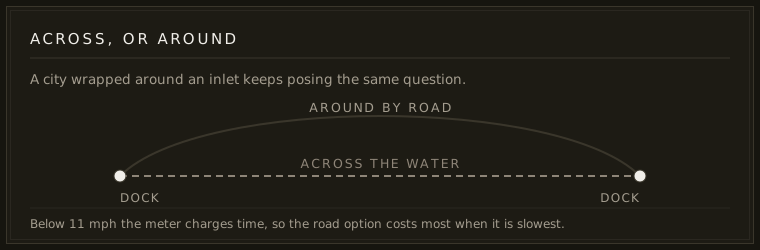
Seattle is wrapped around an inlet, and every crossing decision comes down to the same trade: the water is short and the road around it is long. A route that measures a couple of miles across Elliott Bay measures considerably more by land, and the land version passes through the parts of the network that congest first.
The comparison worth making is not water taxi against taxi in the abstract, but water taxi against the road distance it replaces. A crossing of Elliott Bay is short; the drive around it is not, and it passes through the part of the network most likely to be congested at the times people most want to travel.
Against that, a ferry runs on a timetable and a cab does not, which reverses the advantage outside sailing hours or when the connection at either end is awkward. Below eleven miles an hour Seattle’s metered rate charges time instead of distance, so the case for the boat is strongest exactly when the road option is worst. The rate structure explains why a congested road trip costs more than its mileage suggests.
Questions
Seattle water taxi questions
Is a Seattle water taxi the same as a taxi boat you hire?
No. In Seattle the term means a scheduled passenger-only ferry on a fixed route, operated by King County. You board it like a bus; you do not hire it point to point.
Can you take a car on it?
No, these are passenger-only vessels. That is also why the crossing is quick: there is no vehicle deck to load and unload.
Do the sailings change with the season?
Yes, and it is the detail most likely to catch out a visitor. The winter timetable is thinner than the summer one, particularly early, late and at weekends.
What does the onward taxi from the dock cost?
The ordinary metered rate: $2.60 on entering, $2.70 a mile above eleven miles an hour, $0.50 a minute below it. A dock is not a special zone.